From Mandalay to Yangon | Myanmar's Most Beautiful Train Ride
Published on: 7/18/2026
The window glass reflected my face. People rarely spend their days looking at their own faces. But inside a moving vehicle, when the world outside and your own reflection meet on the same pane of glass, you cannot help but look at yourself. I was traveling from Mandalay to Yangon. Leaning against the blue seat, arms folded, my head resting by the window, I found myself wondering—what is a homeland?
The train sped forward. Yet the fields outside did not seem to move. They carried a strange slowness, as though they belonged neither to today nor even to yesterday, but to a much older time. The wind rolled gently across the green fields, making it feel as if it was not rice swaying, but the long-held breath of generations. Somewhere, white cattle grazed quietly with their heads lowered. Elsewhere, a shepherd stood beside the railway holding a long wooden staff. A lone palm tree stretched into the sky. And I, a traveler sitting behind the glass, felt myself slipping into the pages of old Bengali novels.
Sometimes I think a person's age is not measured by the body alone. I am still young, yet inside me live countless evenings spent reading. So many novels. So many villages, rivers, canals, sandbars, hungry households, silent wives, shepherds, bullock carts, broken courtyards, quiet sorrows, and lives endured without complaint have built their homes within me. That is why, whenever I look at the fields of Myanmar, I remember the Bengal of decades gone by. It feels less like a foreign country and more like an old homeland remembered by another name.
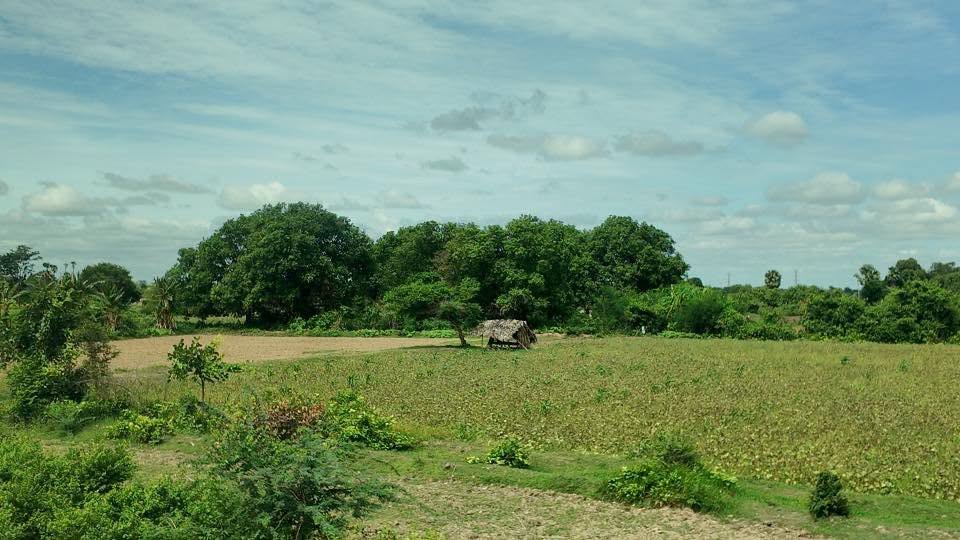
At one point, I saw a tiny thatched hut standing alone in the middle of a rice field. It was hardly a house—more like a shadow. Beside it stood a tree. From a distance I thought it was a coconut tree; as we drew closer, I realized it was not. Yet by then, my mind had already turned it into one. Because the eyes do not merely see—they remember, reshape, and recreate. The ground before the hut had turned pale beneath the sun. A broken clay pot lay on one side, two dogs rested on the other, and a faded cloth the color of dry leaves hung by the doorway. I imagined a young woman stepping outside with a water-filled pitcher. But no one appeared. The train moved on. Life shows us many scenes, but rarely the ending.
My reflection drifted across the glass beside the crown of a palm tree. Do you know how that tree stood? Perfectly upright, as though it had guarded those fields for centuries. Beneath it lay the fields, then a narrow ribbon of water, shrubs along its edge, and beyond them more trees. As I watched, I suddenly thought of Zainul Abedin. Art is not always made with color; even dry lines can paint a story. These fields were full of color, yet beneath them I sensed invisible lines—the lines of poverty, of forgotten people. Lines not drawn on paper, but written into the earth itself.
The sky was a clear blue, scattered with white clouds. Below, the rice fields shimmered in shades of green and gold. Water sparkled in the distance. It was so beautiful that it could make a person cry. Sometimes beauty hurts even more than sorrow, because it reminds us that the world can be this beautiful, and yet human lives can still be filled with hardship.
I could not clearly see the people working in the fields. The train was moving too fast. But I knew they were there. Land this green, canals this full, cattle grazing so peacefully, courtyards pressed smooth with care—none of these could exist without people. People must be there. It is people who wake the earth at dawn. It is people who send smoke rising into the evening sky. It is because of them that the dogs wait beside the doorway, and children run barefoot along the narrow ridges between the fields.
Eventually I did see a group of children. They were playing some game I could not make out. They ran, stopped, then ran again along the edge of the fields. There were no phones in their hands, no glowing screens, no iron cities around them. They belonged to the soil. This is something we often forget in the name of progress. Yet I am not trying to romanticize poverty. No electricity, no network, no healthcare, no roads—these are real hardships. But even within those hardships, people still breathe beneath an open sky, know the shade of trees, fall asleep to the sound of rain, and measure time by the face of the land. That truth is real too.
Thoughts of my own country grew stronger. I remembered canals filled with water, endless fields, golden rice, bullock-cart wheels sinking into mud, mist resting on rice leaves at dawn, ponds drying beneath the fierce heat of Chaitra, cooking pots left to dry in the courtyard, mud houses beside coconut trees, bamboo groves standing behind them. How many such lives have existed across this subcontinent, and how many still do? The names are different, the languages are different, the religions are different, but the sweat of poor farmers, the shadows of tiny homes, the quiet work of women, and the dusty games of children all carry an uncanny resemblance.
I wondered if, in one of the houses outside my window, a young woman might be washing rice for lunch. Would she ever know that I was seeing her home through the pages of Bengali literature? Would she know that the smoke rising from her kitchen awakened memories of another country's famines, harvests, and novels? Of course not. People simply live their own lives. They do not become characters inside someone else's memories. But I realized that this is exactly where literature is born—when an ordinary home suddenly comes to represent an entire age.
The train never stopped, yet in my mind I stepped into a village.
There was a pond there, lined with palm trees. At dawn two women came to fetch water. One was named May Thei. If the other had been called Rahima, it would not have felt strange; names change across borders, but hard work does not. Their heels were cracked, yet there was no shame in the way they walked. At home waited an elderly father-in-law, a feverish child, and debts hanging over the fields. A man labored between the fields and the market, sometimes sitting silently with a cigarette. A little boy chased after cattle. A little girl pretended to make clay pots from mud. At sunset the cooking fire was lit. Smoke curled upward. Dogs barked. No flute echoed across the village—because real villages are not always filled with music. Often the sound of boiling water in a clay pot is music enough.
During the monsoon, half the village disappeared beneath floodwater. The footpaths became narrow and walking grew difficult. Yet the rice turned greener than ever. In winter people ate puffed rice with onions and salt before heading to the fields. In summer the afternoons burned, and even the dogs searched for shade. And human life? It went on. It survived on little. It endured hardship, humiliation, love. It gave birth to children, buried children, sowed seeds again, harvested again, borrowed again, smiled again. That is how countless countries have lived for generations.
It occurred to me that perhaps the greatest illusion in the world is the belief that everything is new. The trains are new. The mobile phones are new. The maps are new. But hunger is old. The wind over the fields is old. Poverty is old. Clay pots are old. Women's silent tears are old. Children's games are old. The patient eyes of cattle are old. And that is why, sitting behind that window, I felt that for centuries people have moved from one courtyard to another, survived by watching their crops grow, and searched for their destiny among rivers, canals, ponds, and earthen roads.
At one point the train curved gently, revealing a shining ribbon of water beneath the sky. I rested my forehead against the window. The glass felt cool. It seemed to me that this coolness was what memory feels like. No matter how far we travel, it suddenly returns and touches the glass.
Then I understood something. It was true that I was looking at Myanmar. But it was equally true that I was seeing the Bengal of the 1970s. People never see only one country. They see a land intertwined with the books they have read, the histories they have heard, the inherited sorrows they carry, and the images left behind by art. That is why the palm tree no longer seemed like only a tree—it became time standing still. The thatched hut was no longer merely poverty—it became the resilience carved into human bones. The children playing became not simply children, but civilization's oldest joy. And the white cattle reminded me that the world had not yet become entirely made of iron.
As the signs of Yangon slowly appeared on the horizon, I felt an unexpected emptiness. It was as though an old novel was coming to an end. Yet novels never truly end. The fields I had passed still swayed in the wind. Someone was still washing rice in the house I had left behind. The dog still lay in the courtyard. The children would soon return home before sunset. Someone would scold them. Someone would serve them rice. Someone would wash at the edge of the yard. Night would fall. Darkness would spread. There might be no lights in the distance, but beneath the open sky they would fall asleep.
I would arrive in the city.
They would remain in the village.
And yet, for one brief stretch of time through a train window, I felt I had lived among them.
That fleeting moment is literature.
That fleeting moment is memory.
That fleeting moment is home.
And one thought remained with me:
There are villages in this world that belong to no single nation.
They belong only to humanity.
They have existed for a very long time.
They still exist.